Airbnb: Italian Villages
A documentary survey for Airbnb and MiBACT
Airbnb Borghi Italiani is the documentary photography campaign I joined in 2017 as a member of the Awakening collective, part of the “Italian Villages” strategic plan promoted by Airbnb in partnership with 18 Italian Regions and MiBACT (Ministry of Cultural Heritage and Activities and Tourism).
The project was launched to promote the historical and architectural heritage of Italy’s small towns internationally, forming part of the wider national itinerary Viaggio Italiano. The campaign aimed to connect travellers with the country’s minor and lesser-known centres, supporting local economies outside traditional mass tourism routes.
My fieldwork covered four of the villages selected for the international promotion plan:
Dozza (Emilia-Romagna)
Dozza, in the hills above Bologna, is known as Italy’s “painted wall” village: since 1960 the Biennale del Muro Dipinto has invited artists from Italy and abroad to cover the facades of its medieval centre with murals, and more than a hundred works now line its streets. The settlement’s roots reach back to Bronze Age finds unearthed nearby, though the village as it stands took shape around the year 1000 on a ridge above the Sellustra valley. It is dominated by the Rocca Sforzesca, a thirteenth-century fortress enlarged in the late sixteenth century under Caterina Sforza, whose furnished rooms, kitchens and dungeons remain open to visitors alongside the regional wine cellar housed within its walls.


Moresco (Marche)
Moresco takes its outline from the Torre Eptagonale, a 25-metre seven-sided tower raised in the fourteenth century on the highest point of the hill, built over the base of an earlier thirteenth-century structure and used historically to coordinate the defence of the surrounding castle. Roman-era finds suggest even earlier occupation of the site, though the earliest documented castle dates from the closing years of the eleventh century. First recorded as a fortified settlement around the year 1000, the village’s elliptical historic centre still converges on a small triangular square, one of the reasons it is listed among Italy’s official “most beautiful villages”.


Città Sant’Angelo (Abruzzo)
Città Sant’Angelo, above the Adriatic coast in the province of Pescara, traces its urban form to a Roman-era settlement and appears in records from the twelfth century as Castrum Sancti Angeli. In 1239, during the conflict between Emperor Frederick II and Pope Gregory IX, the town’s loyalty to the papacy led to its destruction on imperial orders, though it was later rebuilt. Its historic centre stretches along a single elongated main street lined with medieval side alleys, at the end of which stands the collegiate church of San Michele Arcangelo, raised to collegiate status in 1353 and completed with a fifteenth-century portico and coffered ceiling.


Bitti (Sardegna)
Bitti, in the Barbagia region of central Sardinia, has been inhabited since prehistory, with Nuragic remains at the nearby Romanzesu archaeological site dating back roughly five thousand years. The town gives its name to the surrounding Barbagia di Bitti and passed through the medieval Giudicato of Gallura before Aragonese and later Savoyard rule; a document from 1173 already records it by name. It remains one of the principal centres of tenore singing, the male four-voice polyphonic tradition that UNESCO recognised in 2005 as a Masterpiece of the Oral and Intangible Heritage of Humanity, still performed in the village today.


The photographs integrate a survey of the urban landscape and architectural heritage, capturing the material identity of this part of the Italian territory.
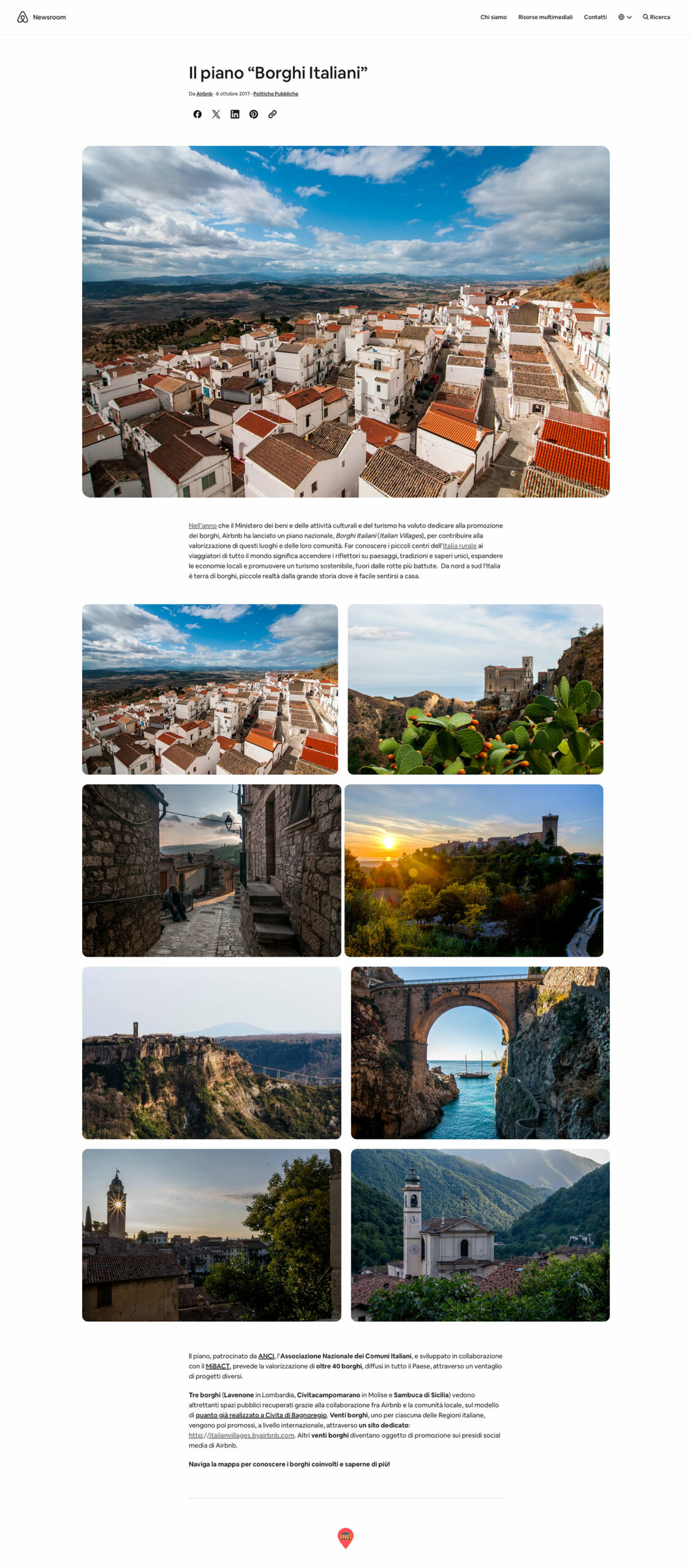
Since 2017, the Borghi Italiani itinerary has continued to grow, with Airbnb and MiBACT extending the promotional plan to further villages across Italy’s regions in the years that followed, building on the same strategy of steering visitors toward smaller, lesser-known centres rather than the country’s already crowded tourist routes.